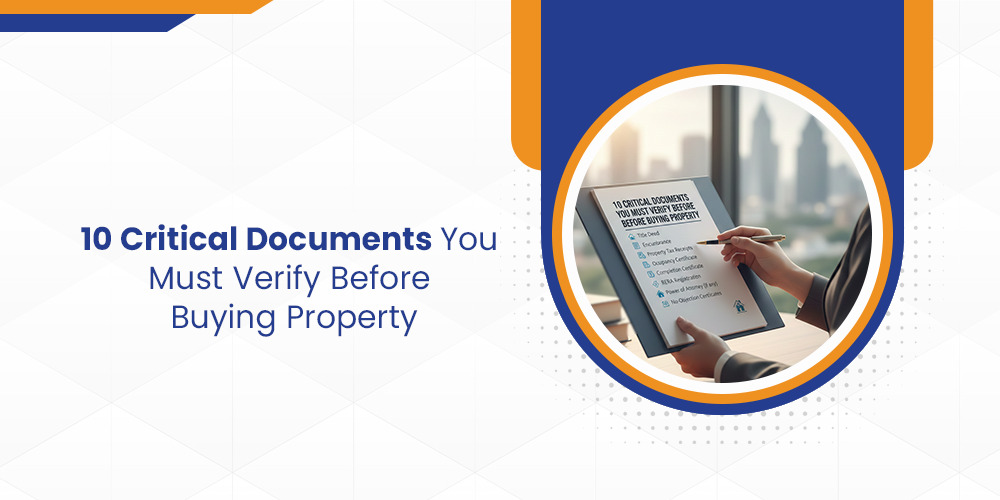
The legal documents required before buying property in India commonly include the title deed, sale deed, previous ownership documents, Encumbrance Certificate, property tax receipts, approved building plan, Completion Certificate, Occupancy Certificate, RERA registration details, and applicable municipal, revenue, land, or society records. A property lawyer should verify these documents to confirm ownership, identify encumbrances, and check whether the property can be legally transferred.
Buying a property is a major financial decision. Before you pay a token amount or sign the agreement, it is important to know whether the seller actually has a clear and transferable title.
This is where property legal verification in India becomes important. Whether you are buying a flat in Pune, a house in PCMC, a plot of land, or a resale property, checking the right documents can help you identify ownership disputes, unpaid dues, mortgages, approval issues, and other risks before they become expensive problems.
A property may look perfectly fine on the outside, and the seller may provide what appears to be a complete set of documents. But property ownership is established through a chain of legal records, not just one document.
Proper verification helps determine:
A useful principle for buyers is:
“Banks don’t approve your loan - they approve your property.”
A bank's legal team checks the property because it will become security for the loan. However, bank approval should not be treated as a complete substitute for independent legal verification.
The exact documents depend on the type, location, age, and history of the property. A lawyer should determine which records are applicable to your particular transaction.
The title deed and earlier ownership documents establish the property's ownership history.
Why it matters: The buyer needs to confirm that the seller has a legally transferable title.
Risk if ignored: A missing link in the ownership chain can result in future claims, disputes, or difficulty proving your title.
For older resale properties, checking previous deeds is especially important rather than relying only on the seller's latest document.
The registered sale deed shows how the current owner acquired the property and records the previous transfer.
Why it matters: It helps confirm the parties involved, property description, registration details, and nature of the transfer.
Risk if ignored: Inconsistencies in the sale deed or earlier transactions may create questions about ownership.
An Encumbrance Certificate (EC) helps identify registered transactions and certain registered charges or encumbrances affecting the property for the relevant period.
Why it matters: It can reveal registered mortgages, transfers, or other transactions that require investigation.
Risk if ignored: A buyer may proceed without knowing about a registered charge or transaction connected with the property.
An EC is important, but it should not be treated as the only proof that a property has no legal dispute. It needs to be reviewed along with the title documents and other records.
The latest property tax receipts and relevant municipal records should be checked.
Why it matters: They help confirm payment of applicable property taxes and provide another point of comparison for the property's municipal details.
Risk if ignored: Outstanding dues or discrepancies may create problems during the transaction or transfer.
For properties in Pune and PCMC, the relevant municipal records should be checked according to the property's jurisdiction.
For a constructed property, the sanctioned building plan should be compared with the actual construction wherever applicable.
Why it matters: It helps establish whether the construction was approved by the competent authority.
Risk if ignored: Unauthorised construction or major deviations can create problems relating to resale, financing, regularisation, or municipal action.
The Completion Certificate (CC) and Occupancy Certificate (OC) are important documents for completed buildings, subject to the property's circumstances and applicable authority.
The CC relates to completion of construction in accordance with applicable requirements, while the OC generally indicates that occupation of the building has been permitted by the competent authority.
Risk if ignored: Missing or problematic completion and occupancy approvals can create legal and practical difficulties for the owner.
For projects covered by the Real Estate (Regulation and Development) Act, 2016, buyers should check the project's RERA registration and relevant disclosures.
Why it matters: RERA records can provide information about the promoter, project, approvals, development status, and other disclosures.
Risk if ignored: Buyers may miss important information about the project's legal and development status.
Depending on the property and jurisdiction, records such as Khata-related documents, mutation entries, property cards, 7/12 extracts, or other revenue and municipal records may need to be examined.
Why it matters: These records help connect the property with government or municipal records.
Risk if ignored: Differences between title documents and government records may indicate issues requiring further investigation.
For land purchases, applicable Non-Agricultural (NA) orders and land-use or conversion records should be checked where relevant.
Why it matters: The buyer needs to establish whether the land can legally be used for the intended purpose.
Risk if ignored: Restrictions on land use can affect construction, development, and the property's future use.
For resale flats in a cooperative housing society or similar association, relevant society documents should also be checked.
These may include the share certificate, society dues, transfer-related documents, and NOC where applicable.
Why it matters: A flat transaction may involve both the property and the buyer's rights and obligations within the society.
Risk if ignored: Outstanding dues or transfer issues can delay the transaction or create problems after purchase.
A practical property verification process generally follows these steps:
For buyers using home finance, understanding the role of a legal search report for home loan can be helpful before submitting the property for bank approval.
Factor | Bank Legal Check | Independent Lawyer Verification |
Main objective | Assess property as loan security | Protect the buyer's legal interest |
Title review | Based on bank requirements | Buyer-focused title due diligence |
Loan approval | Central consideration | Not the primary objective |
Ownership history | Checked | Examined in greater legal detail |
Buyer-specific concerns | Limited | Can be specifically investigated |
| Overall purpose | Manage bank lending risk | Identify legal risks before purchase |
Therefore, a bank's approval is useful, but buyers should not assume that it guarantees the absence of every possible legal issue.
A Real-World Risk Scenario
Imagine a buyer purchasing a resale flat in Pune. The seller provides the latest sale deed, tax receipts, and society documents, so the buyer assumes everything is in order.
The buyer then applies for a home loan. During the bank's legal review, an issue is found in the previous ownership documentation, and additional records are requested. The loan is delayed and the buyer now has to negotiate with the seller to resolve the problem.
A similar issue can arise when a buyer discovers an ownership claim, registered charge, or approval problem only after entering into the transaction.
This is why property due diligence in India should ideally happen before the buyer becomes financially committed, not after problems appear.
For a property buyer, legal verification is not simply about collecting a checklist of documents. The real question is whether those documents collectively establish a legally acceptable and transferable title.
Legal Assure is a Pune-based legal organisation specialising in property verification, title search, and property-related legal due diligence. Its approach focuses on examining the ownership chain, supporting property documents, applicable government records, and transaction-specific legal requirements.
For buyers in Pune and PCMC, this local understanding is particularly useful because property transactions can involve different municipal, revenue, development, and society records depending on the location and type of property.
If you are planning to buy a flat, house, plot, or resale property, consider professional property verification in Pune before finalising the transaction.
You can also explore Legal Assure's related services for property valuation, which addresses the financial assessment of a property separately from its legal title and ownership verification.
What documents are required for property verification?
Common documents include the title deed, sale deed, previous ownership documents, EC, property tax receipts, approved building plan, CC, OC, RERA details where applicable, municipal or revenue records, and society documents for applicable properties.
What is EC in property?
EC stands for Encumbrance Certificate. It helps identify registered transactions and certain registered encumbrances relating to a property for the relevant period.
Can I buy property without legal verification?
It is possible, but doing so increases the risk of overlooking title defects, encumbrances, ownership disputes, documentation gaps, or approval issues. Independent legal verification is strongly advisable for a major property purchase.
Does bank verification guarantee property safety?
No. A bank primarily evaluates the property for its lending and security requirements. Bank verification should not automatically be considered a complete substitute for independent buyer-focused legal due diligence.
How long does property verification take?
The time depends on the property's history, document availability, and complexity. Straightforward cases can be completed relatively quickly, while properties with older ownership chains or documentation gaps may require additional investigation.
Is title verification necessary before taking a home loan?
Yes. Banks generally conduct their own legal assessment, but buyers should also understand the property's title and legal position before committing their funds or signing the final transaction documents.