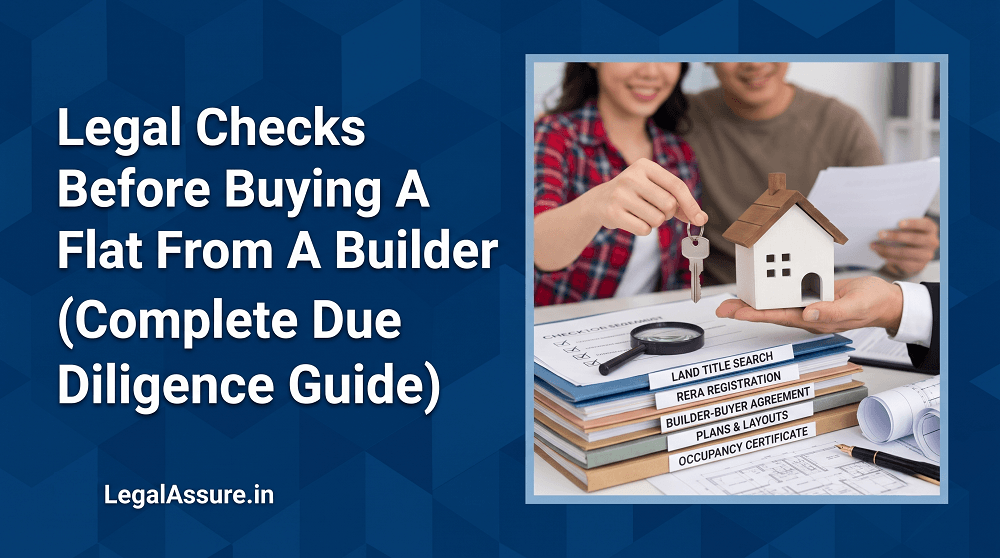
The perfect flat. The view is great, the amenities look luxurious on the brochure, and the builder is pushing you to sign the dotted line right now to "lock in the best price."
Stop right there.
Buying a home is probably the biggest financial decision of your life. But here is the hard truth: a beautiful brochure does not guarantee a legally safe property.
Every year, thousands of homebuyers in India get stuck in legal battles over delayed possessions, unapproved building plans, or disputed land titles.
You don't want to be one of them.
As legal experts at Legal Assure, we have seen countless property deals go wrong simply because the buyer skipped basic due diligence.
To protect your hard-earned money, you need to look past the marketing hype. Here is the ultimate checklist of 15 non-negotiable legal checks every homebuyer must do before paying a token amount to a builder.
Never take the builder’s word that they own the land.
You need to ask for the Title Deed. This document proves that the builder actually has the legal right to sell the property. If the land was purchased by the builder, ask for the Mother Deed to trace the ownership history.
Pro Tip: Always have a property lawyer verify these documents. A clear title means no one else can claim ownership of your flat later.
Since 2016, the Real Estate (Regulation and Development) Act (RERA) has been a lifesaver for homebuyers.
Is the project registered under RERA? If not, walk away.
Every state has a RERA website. Go online, enter the project's registration number, and check:
The actual deadline for project completion.
Whether there are any legal cases against the builder.
If the project layout matches what they are selling you.
What if the builder has taken a massive loan against the land your flat is built on?
An Encumbrance Certificate (EC) will tell you exactly that. It serves as proof that the property is free from any monetary or legal liabilities. Always ask for an EC covering the last 13 to 30 years.
Just because a building is being constructed doesn't mean it's legal.
Builders must get their building plans approved by the local municipal authority. If they add an extra floor without permission, that floor is illegal. Ask to see the Approved Building Plan and ensure the flat you are buying is part of it.
These two sound complicated, but they are simple.
The IOD outlines the conditions a builder must meet before starting construction. Once those are met, the authorities issue a Commencement Certificate (CC).
If the builder doesn't have a CC, the construction is illegal. Period.
In India, you cannot build residential flats on agricultural land.
The builder must get the land legally converted for non-agricultural (NA) residential use. Ask for the NA Order to ensure the land conversion was done legally by the local planning authority.
If you are buying a ready-to-move-in flat, this is your most important document.
An Occupancy Certificate (OC) is issued by the municipal corporation to certify that the building has been built according to the approved plans and is safe to live in.
Warning: Without an OC, you will struggle to get a water connection, electricity connection, or a home loan.
Here is a quick hack to check a builder’s credibility.
Ask the builder which banks have approved the project for home loans. Leading banks (like SBI, HDFC, or ICICI) conduct their own strict legal checks before approving a project. If top-tier banks have approved the project, it is a strong sign that the legal paperwork is in order.
This is the contract that binds you and the builder.
Do not just skim it. Read every single clause. Builders often draft these agreements to favor themselves. Look out for:
Hidden charges.
Unfair penalty clauses (e.g., they charge you 12% interest for late payments, but only pay you 2% if they delay possession).
Alteration clauses that allow them to change the floor plan without your consent.
A large residential project needs multiple NOCs from various government departments, including:
Water Board
Electricity Board
Fire Department
Pollution Control Board
If the builder is missing the Fire NOC, for example, the building is a major safety hazard.
If the builder hasn't paid property taxes on the land, the government can seize it.
Ask to see the latest property tax receipts. Ensure the name on the receipts matches the name on the Title Deed, and that there are no pending dues.
When you buy a flat, you aren't just buying the apartment; you are also buying a small fraction of the land it sits on. This is your Undivided Share (UDS).
Ensure your UDS is explicitly mentioned in your agreement. The higher your UDS, the higher the actual value of your property.
Builders love selling you the "Super Built-up Area" (which includes lobbies, stairs, and elevators).
But you only live in the Carpet Area (the actual usable space inside your flat). Under RERA, builders are legally required to quote the price based only on the Carpet Area. Make sure this is clearly stated in your contract.
What happens if you face a financial emergency and want to exit the project?
Check the default clause in your agreement. Find out exactly how much money the builder will deduct as a cancellation fee, and how long it will take for them to refund the rest.
"We will give you the keys by Diwali."
Don't fall for verbal promises. The exact date of possession must be written in the agreement, along with a grace period (usually 6 months). More importantly, check the penalty clause: What compensation will the builder pay you for every month of delay?
Yes, doing these 15 legal checks takes time. Yes, reading through dense legal agreements can be frustrating. But skipping them is a risk you simply cannot afford to take.
Remember, sales teams are paid to sell you a dream. It is your job to make sure that dream is legally sound.
Need a professional to review your property documents?
Don't navigate this maze alone. At Legal Assure, our expert property lawyers will audit the builder’s documents, vet your buyer agreement, and ensure your investment is 100% secure.
Contact Legal Assure today for a complete property document verification before you sign.