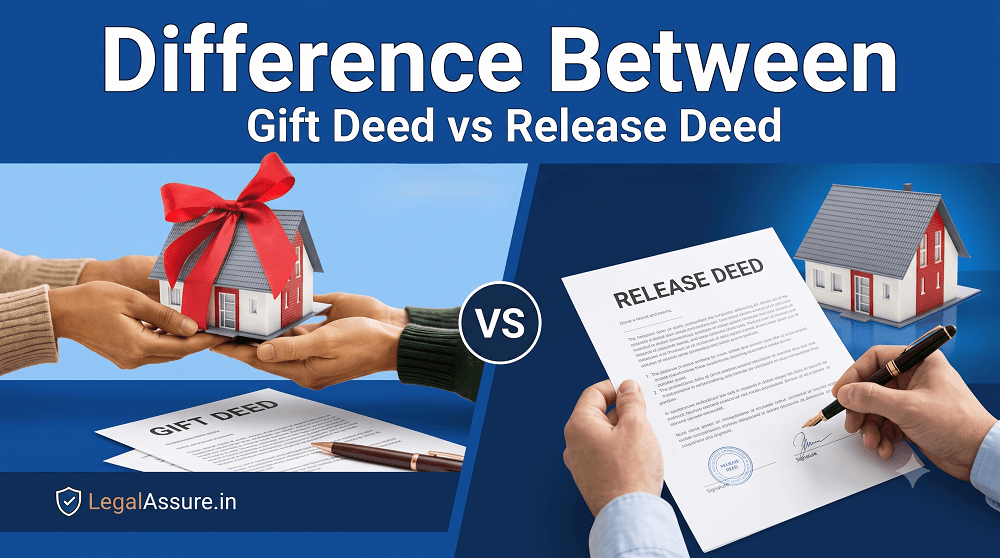
Imagine this: your father owns a flat in Pune and wants you to have it while he's still around to see you enjoy it. He mentions this to a friend, who says "just do a gift deed." Then a relative who dabbled in property once says, "no, no, a release deed is cheaper." Your father calls you, confused, and now you're Googling at 11 PM trying to figure out which one he actually needs.
This mix-up happens in almost every Indian family at some point, and it's not a small thing to get wrong. A gift deed and a release deed serve completely different legal purposes. Use the wrong one, and you could end up paying stamp duty you didn't need to, or worse, create a document that a court later refuses to recognise. For family property transfers in Maharashtra especially, the two are often confused because both are "no cash changes hands" documents but that's really where the similarity ends.
This guide walks through both, in plain language, with the kind of practical detail a property lawyer would actually give you across a table.
A gift deed is a legal document used to voluntarily transfer ownership of a property from one person (the donor) to another (the donee), without any payment or consideration involved. It's governed primarily by Section 122 of the Transfer of Property Act, 1882, and to be valid, it must be signed by the donor, accepted by the donee during the donor's lifetime, and registered.
Key features worth remembering:
Example: Mr. Deshmukh owns a bungalow in Kothrud and decides to transfer it to his daughter while he's alive, so she doesn't have to deal with inheritance procedures later. He signs a gift deed, she accepts it, and it gets registered at the sub-registrar's office. That's a textbook gift deed situation.
Lawyer's Insight: Families often assume a gift deed can be reversed if the relationship sours later say, a parent gifts a house to a child expecting care in old age, and it doesn't work out. Courts have allowed revocation in genuine cases of neglect under Section 23 of the Maintenance and Welfare of Parents and Senior Citizens Act, but this isn't automatic. If you want any conditions attached, they need to be written into the deed itself, not assumed.
Getting the drafting right matters more than most people expect a poorly worded gift deed is one of the most common reasons families end up in court years later. Our gift deed drafting and registration service is built specifically to close these gaps before they become disputes.
A release deed (also called a relinquishment deed, or hakka sod patra in Maharashtra) is used when a person who already has a legal share in a property gives up that share in favour of another co-owner. It doesn't create new ownership it simply removes one person's claim from a property that's already jointly held.
This is the document families use most often after inheritance, when a property has passed to multiple legal heirs and one or more of them decide they don't want to hold onto their portion.
Key features:
Example: After their mother passes away, three siblings inherit her flat in Baner equally. Two of them are settled abroad and don't want the hassle of managing property in India. They execute a release deed in favour of the sibling who lives in Pune, who now becomes the sole owner of the flat.
Lawyer's Insight: A release deed is often the cleanest way to consolidate ownership after inheritance, but it only works cleanly when the property is genuinely co-owned. If your "release" is actually the first time someone acquires an interest in the property (rather than giving up an existing one), the sub-registrar may treat it as a gift or a sale instead, and charge you accordingly.
This is exactly the kind of situation where a quick legal check before signing saves everyone a headache later. Legal Assure's release deed drafting and registration service confirms the property qualifies for the concessional treatment before you commit to anything.
Basis | Gift Deed | Release Deed |
Purpose | Transfers ownership from one person to another out of free will | Surrenders an existing share in jointly owned property |
Applicable To | Any property owned solely (or jointly) by the donor | Only property already co-owned by the releasing party |
Consideration | Must be without payment; otherwise it's not a gift | Can be with or without payment |
Parties Involved | Donor and donee can be any two people | Co-owners of the same property, usually family |
Legal Use Case | Parent-to-child transfers, gifting to relatives, charitable transfers | Family settlements, siblings dividing inherited property |
Stamp Duty (Maharashtra) | ₹200 flat for residential/agricultural property to close blood relatives; 3% of market value for others | ₹200 flat for ancestral property released among specified blood relatives; 5% (conveyance rate) otherwise |
When Should You Use a Gift Deed?
A gift deed makes sense when:
Practical advice: If your goal is a clean, immediate, and irrevocable transfer and the recipient doesn't already own a part of the property a gift deed is almost always the right instrument. Just remember that once it's registered, there's no changing your mind on a whim.
A release deed fits when:
Real-life example: Three brothers jointly inherit their father's ancestral farmland in Baramati. One brother has settled in Mumbai and has no interest in farming. Rather than trying to sell his one-third share to an outsider (which would complicate matters for the other two), he executes a release deed in their favour. The land stays within the family, and he receives an agreed-upon amount as part of the family settlement.
This is where the two documents genuinely diverge, and where getting it right can save a family real money.
Gift Deed:
Under Article 34 of the Maharashtra Stamp Act, 1958, a gift of residential or agricultural property to a close blood relative spouse, child, parent, sibling, or grandchild attracts a flat stamp duty of just ₹200, regardless of the property's value. Gift the same property to anyone outside this defined circle, and the duty jumps to around 3% of the market value, similar to a regular sale. Registration charges of 1% (capped at ₹30,000) apply in both cases.
Release Deed:
Under Article 52, a release of ancestral property, executed without consideration between specified close blood relatives, also attracts a flat ₹200. But this concession only holds if three conditions are all met: the property is genuinely ancestral, no money changes hands, and the parties are within the defined family circle. If any of these isn't true say, the release involves a payment, or the property isn't ancestral it gets taxed at the standard conveyance rate of around 5%, same as a sale deed.
A settlement deed is a third option that often gets mixed into this conversation. Unlike a gift deed, it's typically used to distribute property among multiple family members at once often as part of resolving a broader family arrangement rather than a single transfer from one person to another. Unlike a release deed, it doesn't require the parties to already jointly own the property; a settlement deed can create fresh entitlements for family members as part of an overall plan.
When settlement deed is better: If you're trying to divide a larger estate among several heirs in one go, with different portions going to different people, a settlement deed is usually cleaner than executing multiple gift or release deeds separately.
Consult LegalAssure for property documentation support in Pune our team can review your specific situation, confirm which deed applies, and handle the drafting and registration end-to-end. Whether you need a Gift Deed or a Release Deed, we'll make sure the right one is in place, correctly stamped, and properly registered.
1. Which is better: gift deed or release deed?
Neither is universally "better" it depends on whether the recipient already owns a share in the property. If they do, a release deed fits. If they don't, you need a gift deed.
2. Can a release deed be challenged?
Yes, a release deed can be challenged in court, typically on grounds of fraud, coercion, undue influence, or if it was executed without full understanding of its consequences. Once validly registered and unchallenged, though, it's binding.
3. Is stamp duty lower for a release deed than a gift deed?
In Maharashtra, both can attract the same nominal ₹200 duty when specific conditions are met ancestral property, no consideration, and close blood relatives. Outside those conditions, both are charged at standard conveyance rates.
4. Can a gift deed be revoked?
Generally, no not once it's validly registered. Revocation is possible only in narrow situations like fraud, mistake, or under senior citizens' welfare provisions, and courts examine such cases closely.
5. What documents are needed for either deed?
Typically: proof of ownership or inheritance, identity proof of both parties, property tax receipts, and in the case of ancestral property, documentation establishing the family relationship and lineage.
6. Can NRIs execute a gift deed or release deed for Indian property?
Yes, NRIs can execute both, though it usually involves additional steps like power of attorney if they can't be physically present, and certain RBI/FEMA considerations depending on the property type.