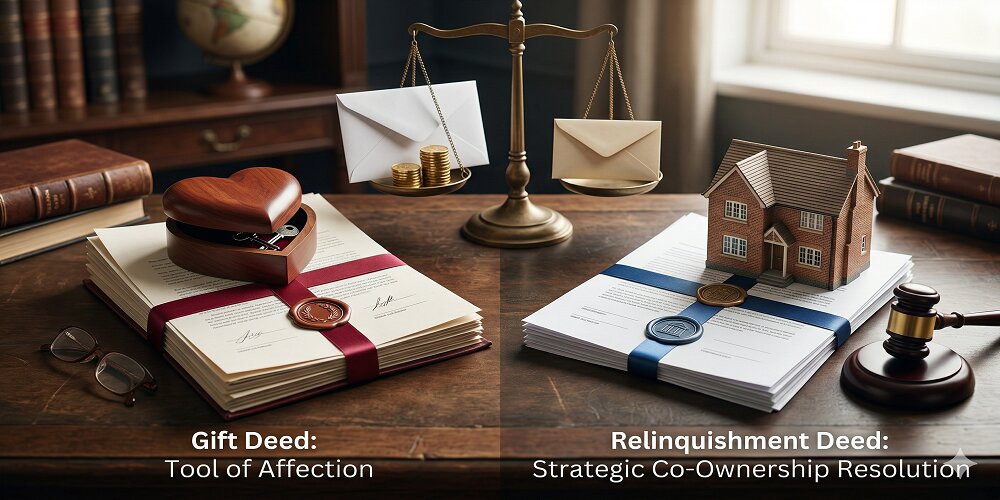
In the high-stakes boardroom of family life, the transition of assets is perhaps the most significant strategic move an individual will ever make. It is an act of stewardship that requires not only empathy and heart but also a sharp, critical eye on practicality and long-term value. I have often observed that families stumble not due to a lack of intent, but because of a failure to choose the correct legal instrument for their specific reality.
When it comes to transferring property, two primary tools dominate the landscape: the Gift Deed and the Relinquishment Deed. Choosing between them is not merely a matter of preference; it is a decision that impacts your family's financial health, legal security, and future harmony.
A Gift Deed is the most direct and versatile way to transfer property during your lifetime. In my years of advising on estate matters, I have found that this tool is often the preferred choice for those who wish to see their legacy take root while they are still present to witness it. It is an "out-of-the-box" solution for providing immediate empowerment to a loved one, whether they are a family member or a trusted friend.
The primary characteristic of a Gift Deed is that it is driven by love and affection, without any monetary exchange. It is a clear-cut, immediate transfer of ownership. However, from a fiscal perspective, one must consider the "operational friction" namely, the stamp duty. While many states offer a discounted rate for transfers within the immediate family, gifting property to a distant relative or a third party can attract the full market-rate stamp duty, which can be a significant drain on your capital.
While a Gift Deed is universal, a Relinquishment Deed is a highly specific, surgical instrument. It is used when a person wishes to release their legal "interest" or share in a property in favour of another co-owner. This is most common in cases of ancestral property or when a parent passes away without a Will, leaving multiple legal heirs as joint owners of the family home.
If you find yourself as a co-owner and wish to consolidate the property under a sibling’s name to ensure better management or development, a Relinquishment Deed is the most efficient route. It is a time-tested principle of property law that you can only relinquish your share to another person who already has a legal claim to that property.
The strategic advantage here is often the cost. Because the law recognises this as a realignment of existing family interests rather than a fresh "sale" or "gift" to an outsider, the stamp duty and registration fees are typically much lower than those of a Gift Deed. It is a cost-effective way to clean up titles and avoid future disputes in the boardroom of the home.
In my practice, I always advocate for "risk mitigation" and "fiscal prudence." To decide which path is right for you, we must look at the nature of the property and the relationship between the parties.
Taking a forward-thinking view means understanding that the cheapest option today might not be the most secure tomorrow. A Gift Deed, once registered, is generally irrevocable, providing absolute peace of mind to the recipient. A Relinquishment Deed is equally final but requires a pre-existing legal relationship to the land.
I encourage every property owner to view these documents not as mere paperwork, but as the blueprints for their family’s future stability. Do not let the complexity of the legal landscape deter you from making a clear decision. Proactive planning is the hallmark of a seasoned executive, and it is the greatest gift you can leave behind.