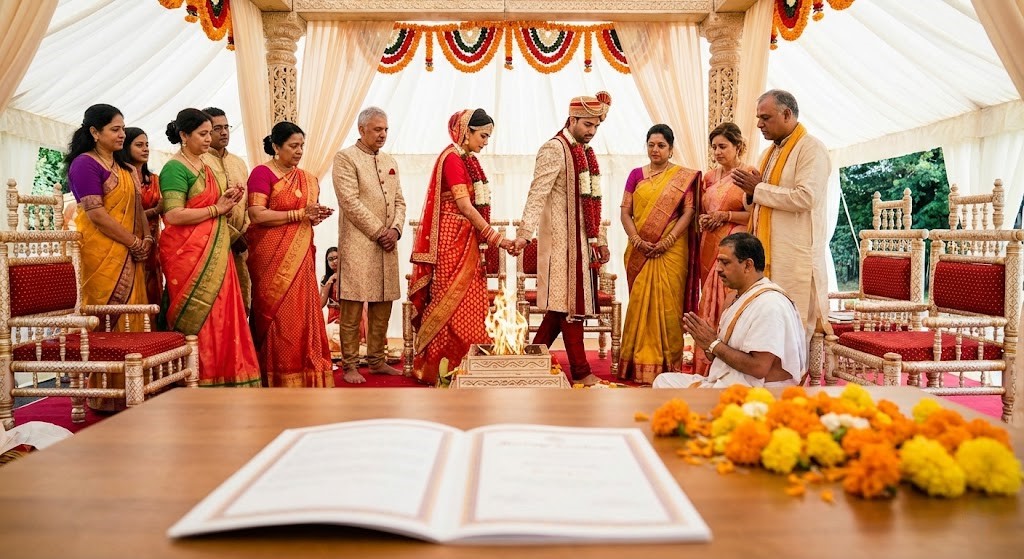
In an era where speed and administrative efficiency often take precedence over tradition, the Supreme Court of India has issued a powerful reminder that some institutions are built on foundations deeper than mere paperwork. In a landmark observation, the Court clarified that a Hindu marriage is a sacred "samskara" a sacrament rather than a commercial contract or a "run-of-the-mill" event to be validated solely by a registration certificate.
For those of us navigating the complexities of modern legal frameworks, this ruling is a breath of fresh air. It reinforces the idea that institutional integrity begins with a respect for the time-tested values that define our social fabric.
The Bench emphasized that for a Hindu marriage to be legally recognized under the Hindu Marriage Act, 1955, the performance of traditional rites and ceremonies is a prerequisite. A marriage certificate, while a vital piece of evidence for administrative purposes, cannot "cure" the absence of the actual ceremony.
In simple terms if the sacred fire wasn't lit and the Saptapadi (the seven steps) wasn't performed, the legal standing of the union remains on shaky ground. The Court was clear that without these foundational rituals, the marriage is essentially non-existent in the eyes of the law.
From a strategic standpoint, this judgment serves as a critical course correction. We often see a trend where individuals attempt to bypass traditional requirements for the sake of convenience, treating marriage as a transaction to be ticked off a checklist. However, the Court’s stance highlights that the "human element", the spiritual and social commitment made through ritual is what provides the union its true legitimacy.
As professionals and stakeholders in the legal ecosystem, we must encourage a holistic view of compliance. Real-world impact is not just about having the right documents in a folder; it is about ensuring that the underlying spirit of the law is honored.
Respecting the Framework: The law isn't just a set of rules; it’s a reflection of our collective heritage. Adhering to the "spirit of the law" ensures long-term stability in personal and legal matters.
Due Diligence: For practitioners and individuals alike, this ruling underscores the importance of proper procedure. Documentation is an outcome, not a substitute, for the act itself.
Preserving the Institution: Marriage is a foundational pillar of society. By upholding its sacramental nature, the Court is protecting the sanctity of the family unit against a purely mechanistic view of human relationships.
Moving forward, this ruling encourages us to think outside the box when it comes to balancing modernization with heritage. We can embrace digital records and efficient registration, but we must never lose sight of the "human-centric" rituals that give these milestones meaning.
The Supreme Court has essentially told us that while the state can record a union, it is the tradition and the community that truly forge it. It is an encouraging call to return to our roots, ensuring that our legal journeys are grounded in authenticity and mutual respect.
At LegalAssure, we believe in a robust, value-driven approach to the law. This judgment isn't just a legal technicality; it’s a testament to the enduring power of our shared principles. Let’s ensure we continue to build our lives and our legal standing on solid, traditional ground. Reference - https://share.google/NnYH3qhTjgN1ACfMY