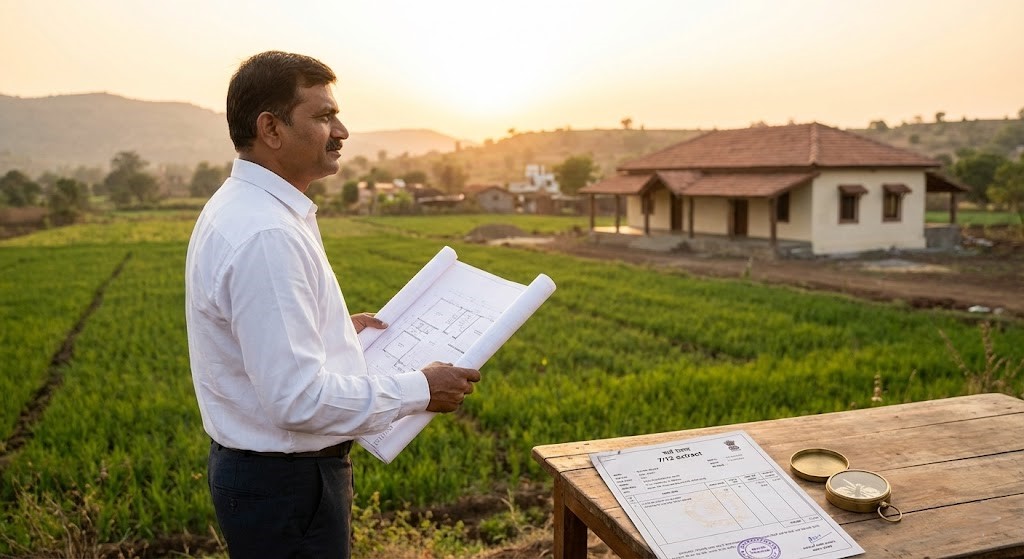
In the strategic management of one’s family estate, the desire to build a home on the serenity of one’s own farmland is a natural and noble ambition. However, as any seasoned professional understands, a vision is only as stable as the legal foundation upon which it is built. In Maharashtra, and indeed across much of our landscape, the transition from "soil to structure" is governed by time-tested principles that ensure the balanced growth of our rural and urban ecosystems.
Recent inquiries into the consequences of unauthorized construction on agricultural land serve as a sobering reminder: ownership of the land does not equate to an absolute right to alter its fundamental purpose without institutional oversight.
At the heart of this issue is the distinction between agricultural and non-agricultural (NA) use. Under the Maharashtra Land Revenue Code, 1966, land is categorized to protect its productivity. Building a permanent residence on land designated for farming without the requisite permissions is not merely an administrative oversight; it is an operational risk that can jeopardize your long-term legacy.
While the law allows for small, temporary structures such as farm sheds or storage for equipment to support the actual work of cultivation, the moment a structure crosses the threshold into a permanent dwelling, the "rules of the game" change.
For a forward-thinking property owner, the shortcuts of today often become the liabilities of tomorrow. Bypassing the conversion process (Section 44 of the MLRC) creates several high-level complications:
Asset Liquidity and Valuation: A property with unauthorized construction is effectively "frozen" in the market. Financial institutions are unlikely to leverage such assets, and sophisticated buyers will shy away from a title clouded by compliance issues.
The Threat of Demolition: While we advocate for an empathetic approach to housing, the state maintains the authority to dismantle structures that violate land-use policies. Relying on "short-term leniency" is not a sustainable business or personal strategy.
Compounding Penalties: Beyond the cost of construction, owners of unauthorized buildings face significant fines and the potential for increased tax liabilities once the violation is identified.
At LegalAssure, we believe in a principled approach to development. If you intend to transform a portion of your farm into a residence, the path forward must be one of transparency and due diligence:
Seek Formal Sanction: Before the first brick is laid, engage with the Collector or Tehsildar to secure the necessary 'NA' permission. This ensures your home is a recognized, legal entity.
Trace the Pedigree: Ensure your land records (7/12 extract) are updated and reflect the current usage. This documentation is the "bloodline" of your property's value.
Think Outside the Box: Strategic planning allows you to balance the preservation of productive land while creating a domestic sanctuary. A well-planned conversion adds value not just to your life, but to the overall portfolio of your family’s assets.
A home is more than a shelter; it is a testament to one's success and a gift to future generations. To ensure that this gift remains a source of pride rather than a legal burden, we must respect the boundaries set by our institutional frameworks. Real-world impact is achieved when we align our personal aspirations with the collective standards of our society. By following the established roadmap for land conversion, you protect your capital, secure your family’s future, and ensure that your legacy is built on the ironclad ground of legal certainty.