
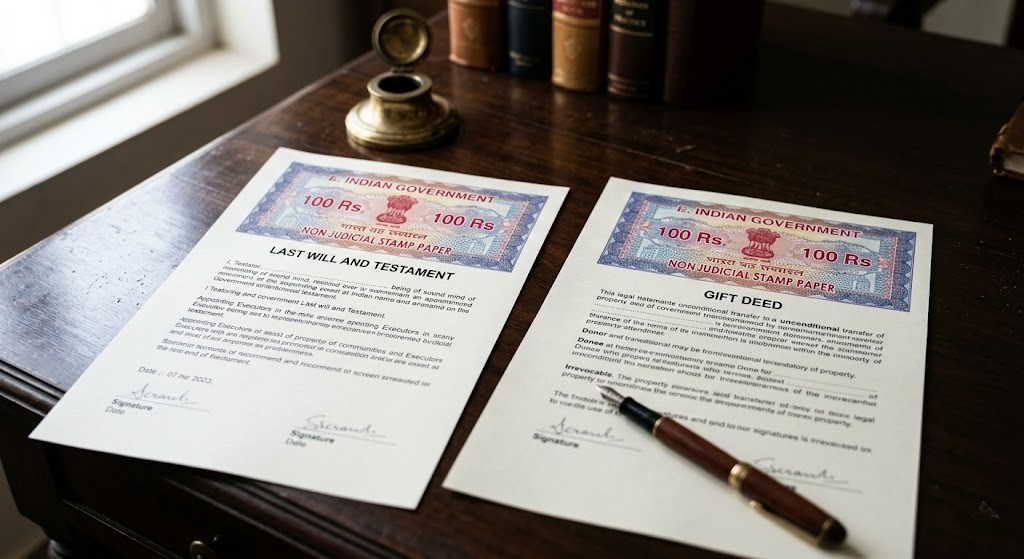
In a time when property disputes are rising across families, choosing the right legal route for asset transfer has become a critical decision. Many individuals are now asking a simple but important question: Should you opt for a will or a gift deed?
Both options serve the purpose of transferring property, but they operate on entirely different principles. Understanding the real benefit lies in timing, control, and long-term intent.
At its simplest, a gift deed allows a person to transfer ownership of property immediately, during their lifetime, through proper gift deed registration. On the other hand, a will comes into effect only after the owner’s death, making will drafting an essential step in estate planning. This distinction is not just technical; it has real-life consequences for families, finances, and legal clarity.
A growing number of property owners prefer gift deeds for one key reason: certainty. Once executed through proper gift deed certification and completed with gift deed registration, ownership is transferred instantly and is generally irreversible. This eliminates the risk of future disputes and ensures the recipient gains clear legal rights without delay.
From a strategic standpoint, this approach works well when:
However, this comes with a trade-off once the property is gifted, control is permanently lost.
A will, by contrast, offers something many individuals value deeply.
It allows the owner to retain full ownership and use of the property throughout their lifetime. More importantly, with proper will drafting and optional will registration, it can be modified or revoked at any time, making it a flexible planning tool.
This makes a will a sensible option when:
That said, wills can sometimes lead to legal challenges or delays, especially if will drafting is not done carefully or lacks clarity.
From a cost perspective, gift deeds usually involve stamp duty and registration charges during gift deed registration, which vary by state. In contrast, wills typically do not require mandatory will registration and carry minimal upfront cost.
Tax implications also differ depending on whether the recipient is a close relative or not, making professional advice essential before taking action.
There is no one-size-fits-all answer. The decision between a will and a gift deed should align with your broader estate planning strategy.
If your priority is immediate transfer and dispute prevention, completing gift deed certification and gift deed registration is a strong approach. If your focus is long-term control and flexibility, proper will drafting, along with optional will registration, remains the more prudent choice.
In practical terms, this is not just a legal decision it is a legacy decision.
When it comes to executing such important decisions, we at Legal Assure believe that the right guidance makes a measurable difference. Based in Pune, we provide end-to-end support for property-related legal work, including will drafting, will registration, gift deed certification, and gift deed registration.
We follow a straightforward approach, ensuring every document is legally sound, properly registered, and fully aligned with current regulations. This helps reduce the risk of future disputes and gives you complete confidence that your intentions will be honoured without complications. Whether you are planning ahead or formalising an existing decision, we ensure the entire process remains efficient, compliant, and stress-free.