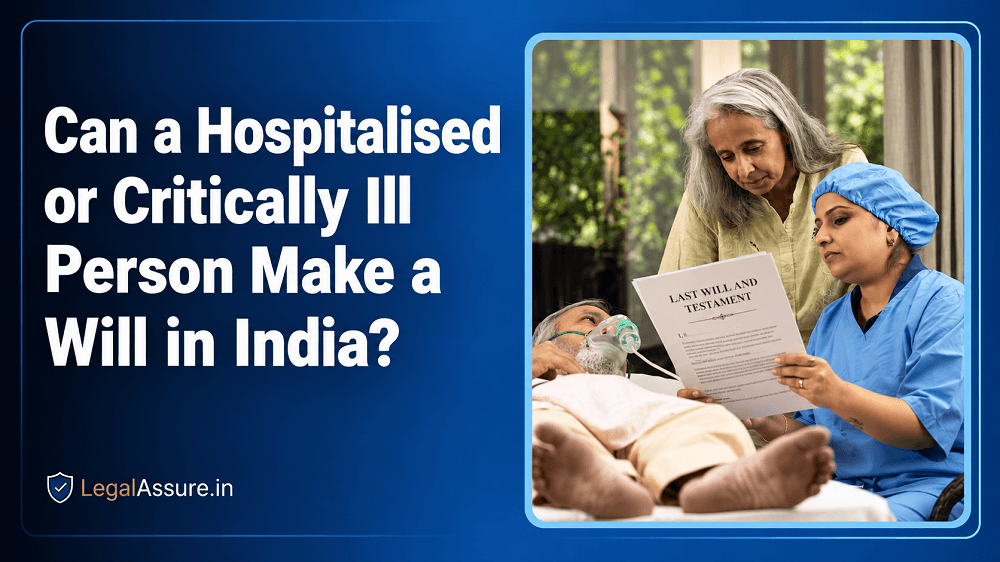
During cancer treatment, after surgery or in critical care, a patient may wish to record their intentions. Can they make a Will from a hospital bed?
Yes. A hospitalised or critically ill person can make a valid Will in India if they have the mental capacity to understand their decisions, act voluntarily and follow the applicable legal formalities. Being physically weak or receiving medical treatment does not, by itself, take away that right.
Section 59 of the Indian Succession Act, 1925, allows an adult of sound mind to make a Will. The law even recognises that a very weak or seriously ill person may make a valid Will if they can still exercise sound judgement.
A patient need not leave hospital to record how their assets should pass after death. But pressure or a lack of understanding can put the Will's validity at risk.
Muslim testamentary succession has different personal-law rules; legal advice must reflect the individual's circumstances.
In simple terms, the person making the Will, called the testator, should understand that they are preparing a document to distribute property after death. They should be able to recognise their main assets, identify the people they wish to benefit and appreciate the likely effect of their choices.
Someone on oxygen support may understand these matters, while a patient who can hold ordinary conversations may still struggle with a complex property decision.
Medication, anaesthesia or delirium can affect alertness. Capacity matters at the time of signing.
An unconscious patient cannot knowingly execute a Will. Where capacity fluctuates, a period of genuine clarity may be relevant, but careful medical and legal assessment is essential.
Respect the patient's privacy and independence throughout.
Confirm that the patient wants to make a Will. Speak directly to the patient, rather than allowing relatives to supply answers.
Check whether the patient can make an informed decision. If medication raises doubts, seek a timely clinical assessment. Medical notes may later help establish capacity.
Write down the assets and instructions clearly. Identify assets, beneficiaries and an executor. Avoid vague instructions.
Have the contents explained and understood. Let the patient read or hear the Will and request changes. Independent legal review can help.
Complete signing and witnessing properly. For Wills governed by Section 63 of the Indian Succession Act, the testator signs or marks the Will, or directs another person to sign in their presence. Two witnesses must attest it according to the legal requirements.
Keep a reliable record. Keep the original safely and record the date, witnesses and relevant medical details. Any video requires consent and hospital-rule compliance; it does not replace witnesses.
Choose independent witnesses who are not beneficiaries or their spouses, avoiding unnecessary disputes and possible legal consequences.
There is no general statutory rule requiring every patient to obtain a doctor's certificate before making a Will. What matters is capacity when the Will is executed.
Still, in cases involving intensive treatment, dementia concerns or strong medication, a contemporaneous medical opinion can be valuable. It should reflect genuine clinical observations.
A certificate alone cannot prove that someone acted freely, understood every provision or complied with witnessing rules. Medical records and witness accounts may matter later.
No. The two documents solve different problems.
| Ordinary Will | Living Will |
|---|---|
| States how eligible property and assets should pass after death | Records certain future medical-treatment wishes |
| Operates after the person's death | Concerns decisions during the person's lifetime |
| Requires the applicable testamentary formalities | Follows a separate advance-medical-directive framework |
A hospital patient may be concerned about both matters, but one document should not be confused with the other.
Legal Assure, based in Pune, assists individuals and families with Will drafting, documentation and registration-related guidance. For hospitalised patients, understanding their mental capacity, independent wishes and applicable legal formalities is particularly important. The team can help families understand documentation requirements, potential legal risks and the steps involved through its Will Drafting and Registration Services in Pune.
For more information about optional registration, read Legal Assure's guide to registering a Will in India.
If your concern relates to medical treatment preferences rather than property inheritance, Legal Assure's Living Will guidance explains that separate legal arrangement.
1. Can a Person with Cancer Make a Will During Treatment?
Yes, if the person understands the nature and consequences of the Will and executes it voluntarily under the applicable law. Cancer alone does not remove testamentary capacity.
2. Is a Deathbed Will Legal in India?
A Will made shortly before death is not automatically invalid. Mental capacity, free choice, proper execution and supporting evidence determine its validity.
3. Can a Bedridden Person Use a Thumb Impression?
A testator may use a mark instead of a signature under the ordinary execution rules, provided the intention and witnessing requirements are satisfied. Inability to write is not an automatic bar.
4. Can Relatives Sign a Will for an Unconscious Patient?
No. An unconscious person cannot knowingly instruct someone to make or sign a Will. Where a conscious person cannot physically sign, the law may permit another person to sign in their presence and at their direction, subject to applicable requirements.
5. Can a Hospital Doctor or Nurse Be a Witness?
They may be suitable if they are willing, competent and genuinely witness the required act. Hospital policies still apply. A medical certificate is not witness attestation.
6. Can Someone in an ICU Make a Will?
ICU admission does not automatically prevent someone from making a Will. However, sedation, confusion or an inability to understand decisions may affect their legal capacity. Medical assessment is particularly important.
7. Can a Will Be Challenged Because It Was Made During Hospitalisation?
Yes, it can be challenged, but hospitalisation alone is not proof of invalidity. Courts may examine medical records, witnesses and possible undue influence.