You’ve found the flat you like, the location works, the price is within your budget, and the seller or builder is ready to move ahead. Then someone asks, “Have you checked the OC?”
That’s usually where the confusion starts.
Homebuyers often hear about a Completion Certificate (CC), Occupancy Certificate (OC), Commencement Certificate and other approvals, but may not know what each document actually proves. This becomes particularly important in Pune because properties may fall under different local authorities, including Pune Municipal Corporation (PMC), Pimpri-Chinchwad Municipal Corporation (PCMC) or another competent planning authority.
If you’re buying a new flat, taking possession or purchasing a resale property, understanding the occupancy certificate vs completion certificate difference can help you identify documentation gaps before committing a substantial amount of money.
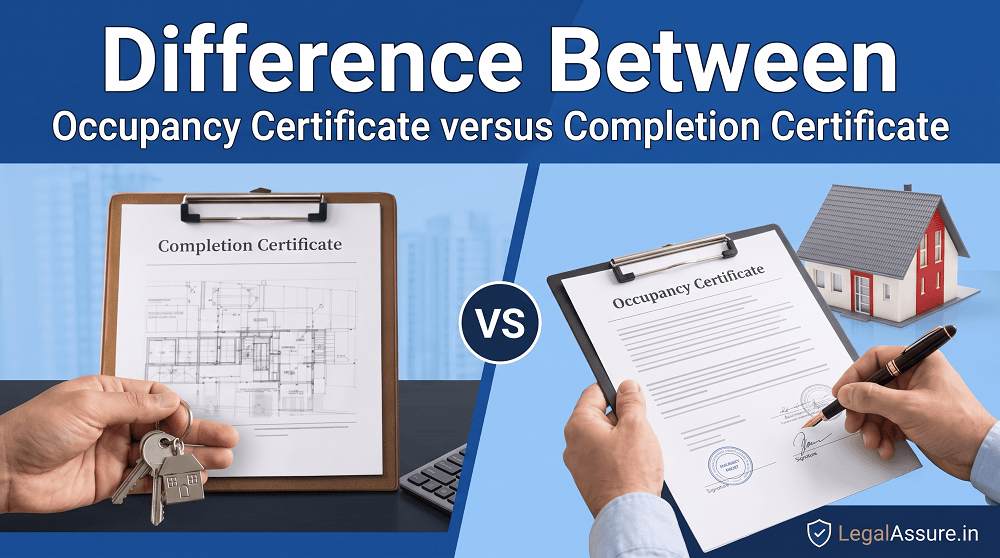
In simple terms, a Completion Certificate generally relates to the completion of construction in accordance with the applicable approved plans and requirements. An Occupancy Certificate relates to the building being permitted or considered ready for occupation under the applicable regulatory framework.
Key Differences Between CC and OC
Parameter | Completion Certificate (CC) | Occupancy Certificate (OC) |
Primary Purpose | Confirms construction adheres to the sanctioned building plans, layout, height, and setbacks. | Confirms the building is habitable, structurally sound, and equipped with civic amenities. |
Sequence | Issued first upon finishing the physical structure. | Issued subsequently after verifying utilities, fire safety, and sanitation. |
Focus Area | Structural and regulatory compliance with building byelaws. | Safety, health norms, and operational utilities like water, electricity, and sewage. |
Legal Occupancy | Does not grant permission to move in or reside in the building. | Mandatory for lawful human habitation and permanent utility connections. |
The terminology and process can vary depending on the authority, project and applicable regulations. That’s why buyers should review the actual documents rather than relying only on a builder, broker or seller saying that “all approvals are complete.”
A Completion Certificate, or CC, is connected with the completion of construction and compliance with the applicable approved plans and requirements.
For a buyer, the important point is not simply whether a document called “CC” exists. You should check what project, building or portion of the development it relates to and whether the details correspond with the property you are purchasing.
The CC should therefore be considered as one part of the property's approval and due-diligence record rather than as a substitute for checking every other relevant document.
An Occupancy Certificate, commonly called an OC, relates to the building's occupation under the applicable regulatory framework.
For a homebuyer, this is particularly relevant when the builder is offering possession or when you are purchasing a completed resale flat.
Pune buyers should also remember that the authority issuing or maintaining building approval records depends on the property's location and applicable jurisdiction. A property within PMC limits may have a different authority record from a property within PCMC limits.
The applicable building regulations also provide that a new building or part of a building should not be occupied until an occupancy certificate is granted.
These three documents relate to different stages of a property's development:
Commencement Certificate: This relates to permission or approval to commence construction, subject to the applicable building and planning regulations.
Completion Certificate: This relates to completion of construction and compliance with applicable approved plans and requirements.
Occupancy Certificate: This relates to the building or relevant portion being ready or permitted for occupation under the applicable regulatory framework.
Think of them as different points in the development process rather than three names for the same document.
A buyer should not look at the OC and CC only as paperwork needed at the time of possession. They form part of the wider property verification process.
For a new project, these documents can help you understand whether the completed building corresponds with the approvals and project information available to you.
For a resale flat, they become part of the historical documentation of the building. You should also examine the seller's title, previous agreements, registered documents, society records, dues and other relevant property records.
They can also become relevant when dealing with financing, future resale and other transactions where a bank, buyer or professional adviser reviews the property's documentation.
For MahaRERA-registered projects, the authority requires promoters to keep project information updated, including document uploads and building-wise completion information.
Instead of asking only, “Does the building have an OC?”, go one step further and verify the document itself.
Ask for a copy of the Occupancy Certificate rather than relying on a verbal statement from the builder or seller.
Review the issuing authority, reference or certificate number, date and property details.
This is particularly important in large projects with multiple towers or phases.
An approval relating to one building does not automatically mean that the same document covers every building in the development. Make sure the OC corresponds to the particular building, wing or tower containing the flat you are buying.
Large developments may receive occupancy approval for a specific portion of the project.
A Part OC can therefore be relevant where construction is completed in phases. If you're buying in Tower B, for example, check whether the document specifically covers Tower B rather than assuming that an OC issued for another completed tower covers your property.
Check the survey or plot information, project name, building name, wing/tower and other identifying particulars against the documents available for the property.
Small inconsistencies should not automatically be treated as proof of a problem, but they should be clarified before you proceed.
Determine which authority has jurisdiction over the property.
For a Pune property, this may involve PMC, PCMC or another applicable planning/development authority depending on the property's location.
Don't assume that every property marketed as being “in Pune” falls under PMC.
If the project is registered with MahaRERA, review the project's available information and uploaded documents. MahaRERA provides project-update mechanisms that include document uploads and building-wise completion information.
MahaRERA records can provide useful additional information, but they should be considered alongside the actual property documents and applicable authority records.
An OC should not be treated as a replacement for broader property due diligence.
Depending on the transaction, you may also need to examine the Completion Certificate, sanctioned plans, title documents, approvals and other records relevant to the particular property.
This is a situation where buyers should slow down and ask for documents.
“OC applied for” and “OC issued” are not the same thing.
Ask the builder to provide documentary evidence of the application and understand its current status. Find out whether the application is pending, whether any requirements remain outstanding and which building or portion of the project the application relates to.
Similarly, statements such as “the CC is available, so OC isn't necessary” or “another tower already has OC” should be verified against the actual documentation and applicable regulations.
You don't necessarily need to assume that the builder has done something improper. But you should avoid making an important financial commitment based only on an assurance that an approval is “in process.”
For a resale property, checking the OC and CC is only one part of the verification process.
You should also review the seller's ownership documents, previous title chain, registered agreements, society or apartment records, outstanding dues, sanctioned/building-related approvals where relevant, and other title or encumbrance-related matters.
This is important because a certificate relating to the building does not by itself establish that the person selling you the flat has clear and transferable title to that particular flat.
For an older building, the documentation may also look different from that of a recently completed project. The applicable requirements can depend on the property's age, location, authority and regulatory framework.
Buying property involves more than checking whether a few certificates are available. The documents need to make sense when considered together.
LegalAssure helps property buyers approach this process through legal due diligence covering relevant title documents, property history, approval-related records, OC/CC documentation, encumbrance-related information and transaction documents.
For a Pune or PCMC buyer, this kind of review can help identify documentation gaps that may not be obvious from a builder's brochure, seller's statement or a single certificate.
The purpose isn't to promise a “risk-free” property. It is to give the buyer a clearer legal picture before making a major financial commitment.
1. Is an Occupancy Certificate the same as a Completion Certificate?
No. A Completion Certificate generally relates to completion of construction in accordance with applicable approved plans and requirements, while an Occupancy Certificate relates to occupation of the completed building under the applicable regulatory framework. The exact process and terminology can vary by authority and project.
2. Can I buy a flat in Pune without an Occupancy Certificate?
The position can depend on the property's status, applicable regulations and transaction circumstances. A buyer should not assume that an OC is unnecessary simply because possession is being offered. Verify the actual approval status and obtain professional legal advice before proceeding.
3. What should I check in an OC before buying a flat?
Check the issuing authority, certificate number and date, project and property details, and most importantly, whether the OC covers the particular building, wing or tower containing the flat. For phased projects, check whether it is a Part OC.
4. What is a Part Occupancy Certificate?
A Part OC relates to a particular completed portion of a larger development. In a multi-tower project, it may cover a specific building, wing or phase. Buyers should verify that the Part OC specifically covers the building in which their flat is located.
5. What if the builder says the OC is still under process?
Ask for documentary evidence of the application and its current status. Find out what remains pending and which building or phase the application covers. “Applied for” should not be treated as equivalent to an OC that has already been issued.
6. Should OC and CC be checked for a resale flat?
Yes, where applicable, they should form part of the building and property-document review. However, resale due diligence should also cover the seller's title, previous ownership documents, registered transaction documents, society records, dues, encumbrances and other relevant property records.