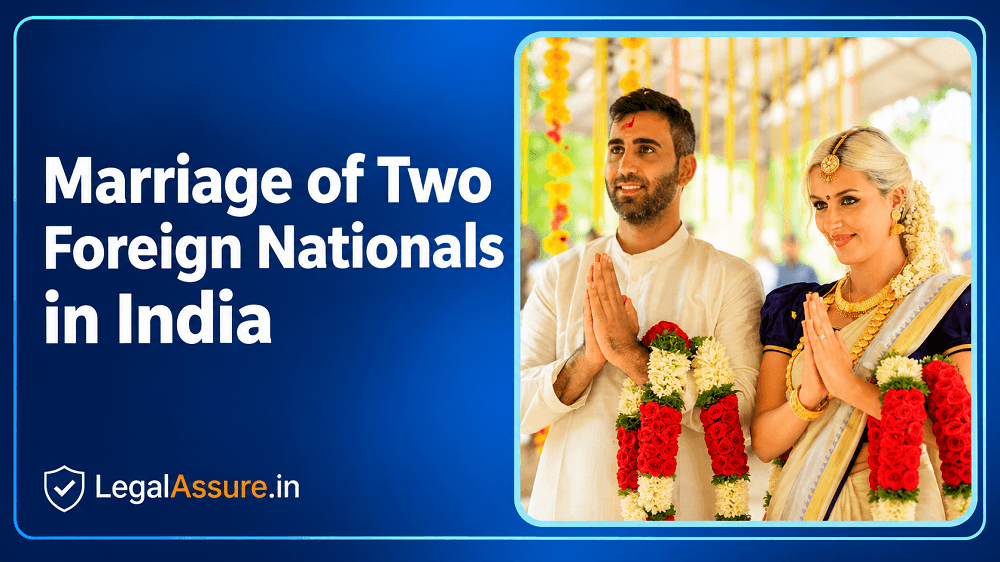
Two foreign nationals may be able to marry in India even if neither is an Indian citizen. The Special Marriage Act, 1954 provides a civil marriage route and allows certain marriages already celebrated in another form to be registered. The applicable process depends on whether the couple wants to marry before a Marriage Officer or has already completed a ceremony.
The two routes have different requirements. A 2026 Delhi High Court decision also clarified the position for two foreign nationals seeking to register an existing marriage in Delhi.
Section 4 of the Special Marriage Act refers to a marriage between “any two persons” and does not make Indian citizenship a general eligibility condition for solemnisation under the Act. The parties must still meet the conditions relating to marital status, consent, age and prohibited relationships.
The Delhi High Court’s September 2026 ruling, reported in October, concerned two Swedish nationals who had undergone a ceremony in India and sought registration. The Court referred to amended Delhi guidelines that allow two foreign nationals to apply under Chapter III of the Special Marriage Act without either applicant being an Indian citizen. The residence condition and other requirements still apply.
The decision concerned Delhi’s guidelines and registration of an existing marriage; procedures may differ in other states.
The Special Marriage Act provides two relevant routes:
Solemnisation under Chapter II: For couples who want to enter into a civil marriage before a Marriage Officer in India. They submit a notice of intended marriage and complete the prescribed notice period before solemnisation.
Registration under Chapter III: For couples whose marriage ceremony has already taken place in another form and who want to register it under the Act. Section 15 sets specific conditions, including that the parties have lived together as husband and wife since the ceremony.
The routes are not interchangeable: a ceremony at a temple or private venue does not automatically become a marriage registered under the Special Marriage Act.
For a new civil marriage under Section 4, the main conditions include:
Neither person should have a living spouse.
Both parties must be capable of giving valid consent.
The male must have completed 21 years and the female 18 years.
The parties must not fall within the prohibited degrees of relationship, unless an applicable recognised custom permits the marriage.
For registration of an existing marriage under Section 15, the conditions differ. Both parties must have completed 21 years at the time of registration; neither can have more than one living spouse; and they must not be within the prohibited degrees of relationship. A marriage ceremony must already have taken place, and the parties must have lived together as husband and wife since then.
The couple should also check the laws of their respective countries, especially where a previous marriage or divorce is involved.
Yes, but the requirement differs by route.
For solemnisation under Chapter II, Section 5 requires at least one party to have resided in the relevant district for 30 days immediately before submitting the notice. Both parties do not need separate 30-day stays for this step.
For registration of an existing marriage under Chapter III, Section 15 requires both parties to have resided within the Marriage Officer’s district for at least 30 days immediately before applying.
In its September 2026 ruling, the Delhi High Court treated the Section 15 residence requirement as a condition determining the Marriage Officer’s territorial jurisdiction. It declined to waive it merely because compliance was inconvenient. Delhi’s amended guidelines also refer to valid visas and proof of current residence for foreign-national applicants.
A further 30-day period is provided for objections after the notice or application under the relevant provisions. Check the applicable timeline before booking travel.
The checklist depends on the route and the concerned Marriage Officer. Documents may include:
Valid passports as proof of identity, nationality and age.
Valid visas or other applicable documents showing lawful stay in India.
Proof of residence in the relevant district.
Photographs and prescribed application forms.
Affidavits or declarations confirming marital status and eligibility.
A certificate of no impediment or marital-status certificate from the embassy or home authority, where required.
A final divorce decree or former spouse’s death certificate, if applicable.
Certified translations, apostille or consular authentication for foreign documents, where required.
The Delhi guidelines discussed in the 2026 ruling require an embassy-attested affidavit, valid visa and residence proof from foreign-national applicants. These are Delhi-specific requirements.
Confirm document formats and authentication requirements with the Marriage Officer before travelling.
For a new civil marriage under Chapter II, the general steps are:
Identify the Marriage Officer: Confirm the district based on the 30-day residence of at least one party.
Submit the notice: Complete the prescribed notice and provide supporting documents.
Complete the notice period: The Marriage Officer publishes the notice. Objections may be raised within 30 days on grounds recognised by the Act.
Attend solemnisation: If the legal conditions are met and no valid objection prevents the marriage, both parties attend before the Marriage Officer.
Bring three witnesses: Section 11 requires the parties and three witnesses to sign the prescribed declaration in the officer’s presence.
Obtain the certificate: After solemnisation, the Marriage Officer records the marriage in the Marriage Certificate Book.
For registration under Chapter III, the Marriage Officer checks the Section 15 conditions, gives public notice and considers objections. If satisfied, the officer records the marriage certificate with the parties and three witnesses.
An Indian marriage certificate is official evidence of the marriage, but recognition in another country depends on that country’s laws and administrative requirements.
An apostille, consular authentication or certified translation may be needed, depending on the country and purpose, such as immigration or updating civil records.
Check the requirements of each person’s home-country authority before the wedding; an Indian certificate may not meet every requirement automatically.
For couples handling marriage documentation in Pune and PCMC, Legal Assure provides assistance with marriage registration and certificate-related formalities, including guidance for NRI and foreign-national cases. Its team can help identify the applicable procedure, review passport and visa details, check supporting documents, and guide applicants through declarations, notice requirements and appointments with the concerned office. The Registrar or Marriage Officer remains responsible for official verification and issuing the certificate. Read more about Legal Assure’s marriage registration and certificate assistance in Pune and PCMC.
1. Can two foreign citizens get married in India?
The Special Marriage Act provides a civil marriage route for “any two persons”, subject to its eligibility and procedural conditions. Confirm the applicable process with the Marriage Officer.
2. Do both foreign nationals need to stay in India for 30 days?
For a new civil marriage, at least one party must meet the 30-day district residence condition before giving notice. For registration of an existing marriage, both parties must meet the 30-day residence condition.
3. Is an embassy No Objection Certificate compulsory?
There is no single embassy certificate prescribed universally for every foreign-national couple. The authority may require proof of marital status or an embassy-attested affidavit under applicable local guidelines.
4. How many witnesses are required?
The Special Marriage Act requires three witnesses for the relevant declaration and certificate formalities.
5. Will the marriage certificate be valid in the couple’s home countries?
It may be accepted, but recognition, apostille, authentication and translation requirements depend on the relevant country’s laws.